
Pre-Doc Conference 2026

Predoc Conference 2026
The Pre-Doc Conference offers a unique platform for pre-doctoral research assistants in economics and related fields to present their own research and exchange ideas on emerging topics. Organized as a professional development event, attendance is by invitation only.
The Pre-Doc Conference is sponsored by the Industrial Relations Section, the Griswold Center for Economic Policy Studies, Research Program in Development Economics, and the Julis-Rabinowitz Center for Public Policy and Finance.
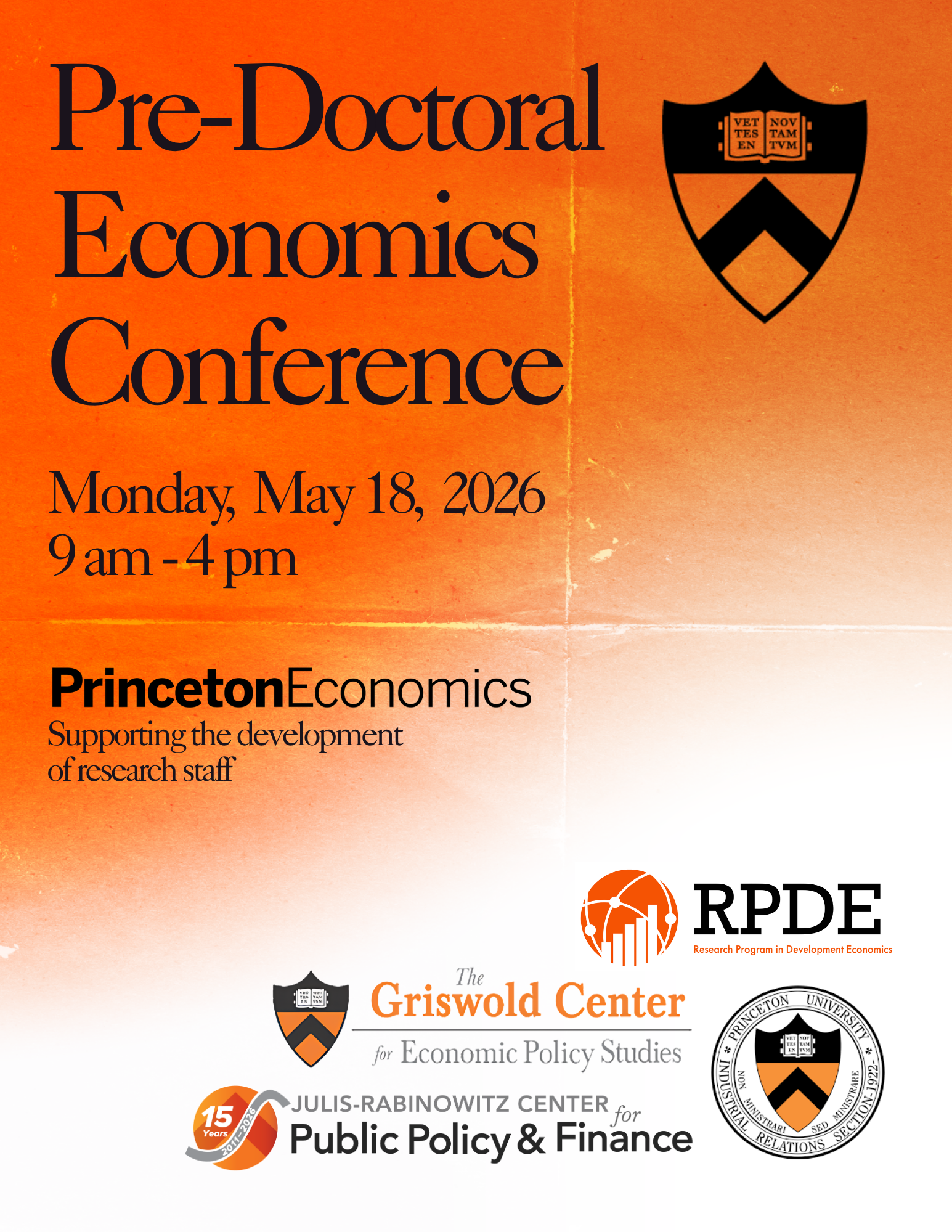
(Poster image by Baz Crow)
| Time | Event | Details |
|---|---|---|
| 09:00am - 09:30am | Breakfast |
|
| 09:30am - 10:00am | Running a Different Race: The Effect of Saldano v. Texas on Racial Bias in Capital Sentencing |
Juan Gaspar Arias |
| 10:00am - 10:15am | Mass Education and the Growth of the American Labor Movement, 1900-1975 |
Dylan Black, Princeton University |
| 10:15am - 11:00am | Running with the Crowd: Peer Effects Using Evidence from Marathon Runners |
Allan Lee, Princeton University |
| 11:00am - 11:30am | Break |
|
| 11:30am - 12:00pm | Do Essays Level the Playing Field? Re-evaluating the Socioeconomic Signal in Holistic Admissions |
Gabriel Koiran Portier, Princeton University |
| 12:00pm - 12:30pm | Cadre Evaluation Reform and Land Finance: Exploratory Evidence from China |
Audrey Wang, Princeton University |
| 12:30pm - 01:00pm | Lunch |

May 18 at 9:30AM
Running a Different Race: The Effect of Saldano v. Texas on Racial Bias in Capital Sentencing
Juan Gaspar Arias
Princeton University

May 18 at 10:00AM
Mass Education and the Growth of the American Labor Movement, 1900-1975
Dylan Black
Princeton University

May 18 10:15AM
Running with the Crowd: Peer Effects Using Evidence from Marathon Runners
Allan Lee
Princeton University
Abstract
Understanding how peer groups shape individual performance is central to the design of schools, firms, and other organizations. Existing literature has largely adopted a static perspective on peer effects, rather than examining how peers dynamically shape productivity based on work period or difficulty of task. In many real-world settings—from classrooms to workplaces—individuals must allocate effort dynamically, and peer groups may serve as salient reference points that influence not just total output but how effort is distributed over time. We exploit quasi-random variation in peer group assignment at the New York City Marathon to estimate peer effects on individual performance and pacing strategy. The New York City Marathon assigns runners to waves based on a best-pace threshold, generating a regression discontinuity in peer group composition at each cutoff. Using finisher data from 2023 to 2025 (n=56,613), we find that assignment to a slower wave has no significant effect on overall finishing time, but meaningfully distorts within-race pacing: runners assigned to slower waves run $1\%$ faster than their predicted pace in the first 5K but $1\%$ slower in 5K segments in the second half of the race. Additional heterogeneity analyses reveal that effects are largest among runners without an affinity to finishing races with round-number finish times, suggesting that peer influence is strongest when runners lack independent pacing anchors. These findings contribute to a growing literature on peer effects in competitive settings and suggest that grouping policies can shape not just total output but the intertemporal allocation of effort within a performance period.